Succeeding in academia is increasingly competitive and a professional proofreader is more useful today than ever before – whether English is your first, second, or third language. Our aim is to make sure your argument is clear and effective without changing the meaning or character of the work, however complex your ideas. For academic work, this includes ensuring the structure of the work presents your thesis in a clear and logical way that conforms to accepted conventions. We can give consistent and intelligent feedback regarding structure, layout, and the cogency of your discussion.
However, academic proofreading also has more far-reaching functions. While the such editing in no way replaces a tutor or other academic support, a proofreader can spot factual errors and contradictions that may be passed over by someone more familiar with your subject.
However carefully you write, you probably find you make minor mistakes that are difficult to pick out  yourself. In fact, anyone familiar with your work is liable to assume you have written what they already know you mean. On the other hand, while computer programs can provide useful guides regarding grammar and spelling, they don’t have an intelligent approach and may make nonsense of sophisticated arguments – although these corrections can occasionally be very funny, they do nothing to further your discussion. So, to ensure your work is presented accurately and clearly, there is no serious alternative to a high-quality proofreader.
In particular, if English is not your first language, having feedback and help with expressing your ideas can ensure that your work reflects your intellectual abilities rather than your use of English. For more information about this, see our ‘English as a Second Language’ page.
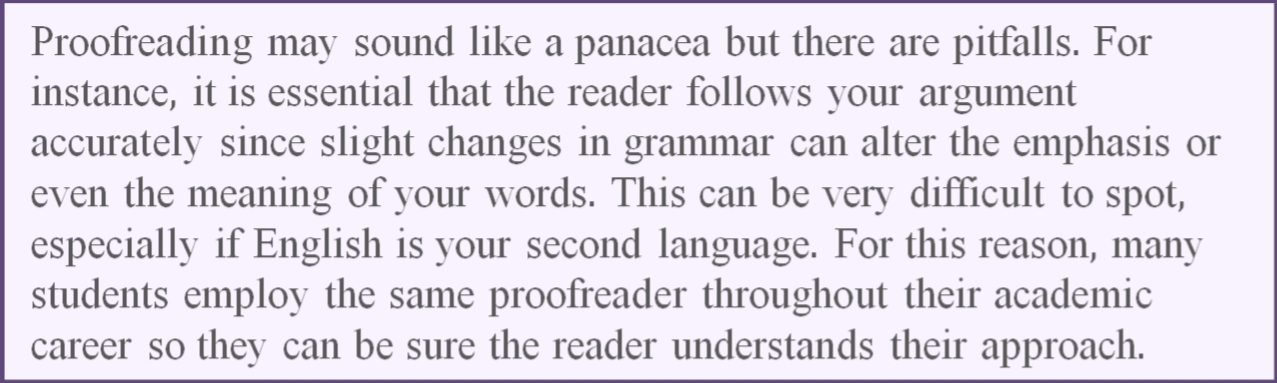
At its most basic, proofreading is a simple and effective way of giving your work its best chance by adjusting clumsy or ambiguous wording that can mislead or distract the reader from its content. This is especially important for work relating to conflict-affected countries, fragile states and interreligious and intercultural dialogue where a correct understanding of an author’s argument is essential.
As well as checking for good grammar and fluent prose, our service includes the following:
-
ensuring chapters and sections are well structured and link into each other effectively
-
pointing out/removing contradictions, inconsistencies or unnecessary repetition
-
ensuring references are correct and consistent
-
ensuring the text conforms to prescribed styles
-
inserting a table of contents and other tables/appendices
-
ensuring diagrams are correctly positioned
-
checking for consistency of spelling and the introduction of abbreviations at first use
-
reducing the length of the work, if necessary
At Inkwell, we can work with you in whatever way most suits your approach. Some students prefer to send the completed work while others may choose to send a first draft to have feedback on the structure and layout before presenting it to their supervisor, while others feel that it’s only necessary to have the final version proofread.
(As the use of gender-neutral pronouns is an active area of language change, I use s/he as a personal preference. However, within texts I proofread, I always follow whichever form is prescribed or preferred.)
. 
k. . .
 Inkwell Proofreading and Editing